
Polished Concrete for Restaurants: Architect’s Guide
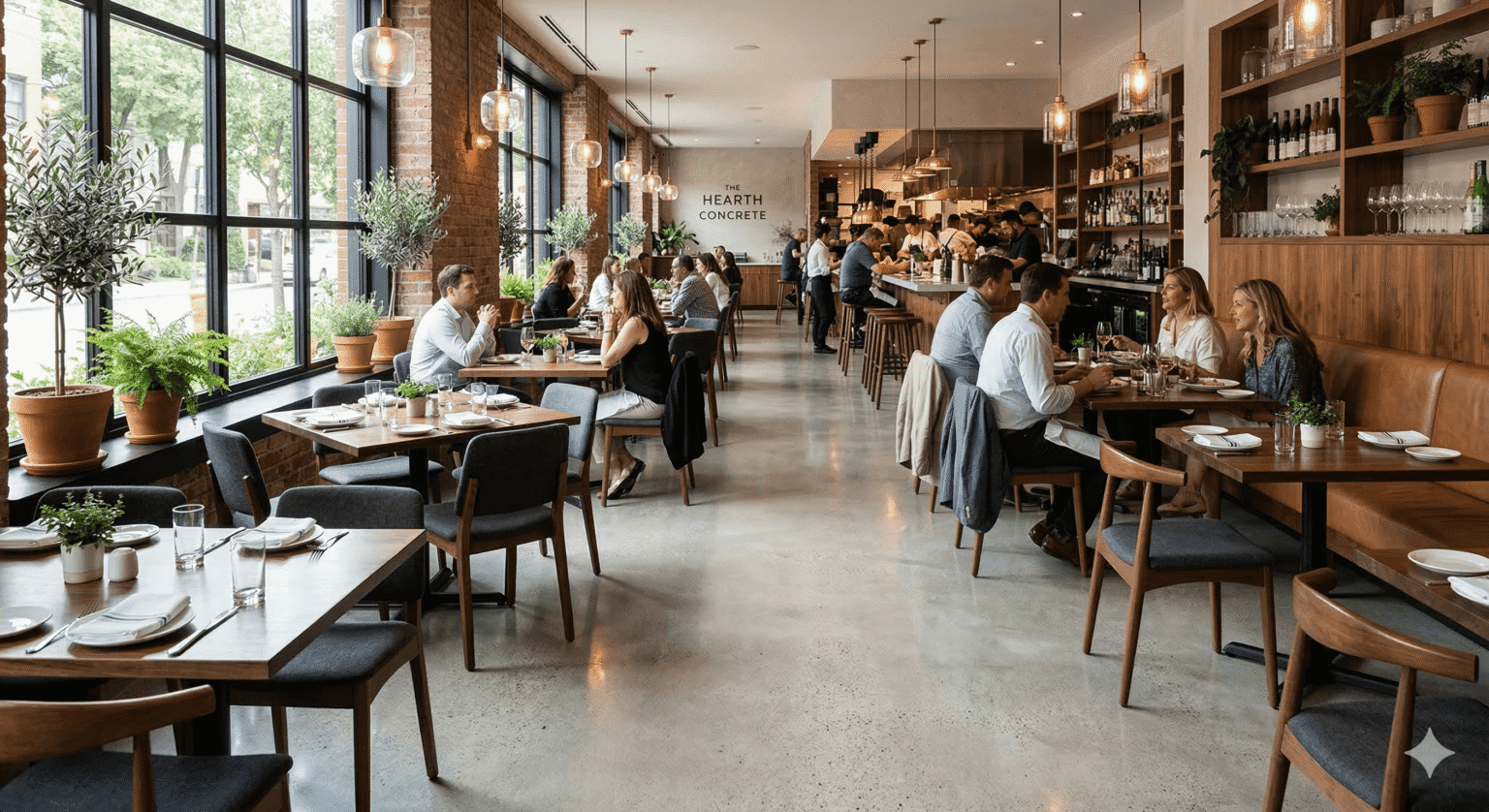
Polished Concrete Floors for London Restaurants and Hospitality Fit-Outs: A Specification Guide
Specifying a floor for a London restaurant is not a simple decision. It is a technical one with commercial consequences that will play out over years of heavy daily use, deep cleans, dragged furniture, spilled acidic drinks, and the kind of sustained foot traffic that would destroy most domestic finishes within a season.
Polished concrete has become one of the most widely specified flooring options across London’s hospitality sector — from neighbourhood bistros in Bermondsey to flagship hotels in Mayfair. Done properly, it is a genuinely outstanding choice. Done poorly, or specified without understanding the material’s behaviour in a commercial kitchen-adjacent environment, it can create serious problems.
This guide is written for architects and interior designers working on restaurant, bar, café, and wider hospitality fit-outs who want to understand what polished concrete can and cannot do, how to specify it correctly, and what to ask of your contractor.
Why Polished Concrete Works Particularly Well in Hospitality
The demand profile of a busy London restaurant is brutal. Consider what the floor is exposed to in a single week: constant foot traffic from open to close, chairs and tables shifting across the surface throughout service, regular mopping with commercial cleaning products, occasional spillages of wine, oil, coffee, and acidic dressings, and the cumulative effect of deliveries, staff movement, and late-night closing routines.
Polished concrete handles all of this well because the polishing and densification process fundamentally changes the surface at a molecular level. Diamond tooling refines the surface through progressive stages, and a silicate-based densifier reacts with the calcium hydroxide in the concrete to form additional calcium silicate hydrate — in plain terms, it hardens and closes the surface without applying a topical film that can peel, scratch, or require periodic stripping.
The result is a surface with exceptional abrasion resistance, good stain resistance when properly sealed, and a reflective quality that performs well under the dramatic lighting typical in contemporary restaurant interiors. It also photographs extremely well, which matters to operators and to your portfolio.
Finish Selection for Restaurant Environments
Not all polished concrete finishes are equal in a commercial hospitality setting. The finish you specify will determine both the aesthetic outcome and the practical performance of the floor. There are broadly three options relevant to restaurant fit-outs.
Salt and Pepper (Cream) Finish
This is the most restrained of the three — the surface is lightly refined, revealing fine sands and a small amount of aggregate, without deeply cutting into the slab. It gives a softer, less industrial appearance. In terms of maintenance, the surface is somewhat more textured at a micro level, which means spillages need prompt attention. For front-of-house dining areas with controlled foot traffic, this finish is a strong design choice. For kitchen-adjacent zones or high-traffic circulation routes, we would typically recommend going deeper.
Variable Finish
The variable finish involves a light grind to create a flat platform before polishing. It produces a cleaner, more consistent appearance than the rustic finish, with fine sands and occasional small aggregates visible. Gloss level is controlled by the number of polishing stages — you can achieve satin through to high gloss. This is the most versatile finish for hospitality: clean enough for a considered interior, durable enough for commercial use, and available across the full colour spectrum for new pours.
Exposed Aggregate Finish
The most heavily processed of the three. The initial grind removes 2–3mm from the surface, exposing the aggregate matrix below. The result is a deeply reflective, terrazzo-like floor with exceptional durability — the most polishing stages, the most surface-closed finish, and the highest resistance to staining. For a flagship restaurant or hotel lobby where the floor is a deliberate design feature, this is the premium option. It costs more to produce and requires a new slab designed for it, but the result is genuinely outstanding.
Critical Specification Considerations for Hospitality
Sealer Selection and Acid Resistance
This is where many specifications fall short. A standard penetrating sealer is excellent for residential and general commercial use — it closes the surface, resists staining, and keeps the floor breathable. In a restaurant environment, however, you are routinely dealing with acidic spillages: vinegar, wine, cider, carbonated drinks, citrus-based dressings. Acids attack concrete and can etch or stain the surface if not cleaned promptly.
The sealer specified must be appropriate for food-service environments, and the client team needs to understand the maintenance requirement: acidic spills should be cleaned up immediately rather than left to sit. A penetrating sealer is not an invisible shield — it creates a window of opportunity to act. With good housekeeping practices, this is entirely manageable. We set this expectation clearly with every hospitality client before we start.
Movement Joints and Floor Planning
Concrete shrinks as it cures. On a large restaurant floor plan — particularly one with structural columns, service penetrations, or a complex footprint — movement joints need to be positioned carefully to control where any shrinkage cracking occurs. These joints can be detailed as feature saw cuts that read as part of the design, or they can be minimised through good joint planning. What they cannot be is ignored. A contractor who does not raise the question of movement joints at specification stage is a contractor who is not thinking about what happens in twelve months’ time.
Kitchen and Wet Area Considerations
Commercial kitchen floors in London are typically specified as resin or tiled systems for compliance reasons — drainage falls, anti-slip ratings, and the demands of environmental health inspections. Polished concrete is generally not appropriate for a commercial kitchen floor unless specifically designed for it. However, it is an excellent choice for pass areas, front-of-house zones, bar areas, and transition spaces — provided the junction between kitchen and dining floor is properly detailed. This is a conversation worth having early in the design process.
For wet areas such as bar surfaces, back bars, or wine cellar floors, the specification needs to address slip resistance, which is affected by both the finish level and the sealer used. High gloss finishes can be slippery when wet. A satin or semi-gloss finish with an appropriate sealer system will give you the aesthetic whilst maintaining a usable slip coefficient.
Underfloor Heating Compatibility
Many London restaurant conversions — particularly in older buildings — incorporate underfloor heating. Polished concrete works well with UFH systems, but the concrete slab must be commissioned correctly. The UFH should be run at low temperatures before grinding commences, to allow the slab to condition and release residual moisture. Running the heating system at full temperature on a newly polished floor before full cure is complete is a reliable way to cause surface crazing and colour inconsistency. Get the commissioning sequence agreed in writing between the M&E contractor and the concrete specialist.
The New Build vs. Refurbishment Question
Most restaurant fit-outs in London fall into one of two categories: a shell-and-core new build or a refurbishment of an existing commercial space. The approach to polished concrete differs meaningfully between the two.
In a new build or ground-up fit-out, you have the opportunity to specify the concrete mix, the slab depth, the reinforcement strategy, and the aggregate design from the outset. This is where polished concrete is strongest — you are designing the floor to be polished, rather than working with what you find.
In a refurbishment, the existing substrate determines your options. If you have a sound concrete slab in adequate condition, grinding and polishing it is frequently viable and can produce outstanding results. If the existing floor is tiled, you are typically looking at removing the tiles, assessing the substrate below, and either polishing the existing concrete or applying a cementitious microcement overlay where floor height constraints prevent a new pour. Both are legitimate routes — the right answer depends entirely on what the survey finds.
What to Ask Your Contractor
Regardless of which contractor you instruct, there are several questions that any reputable specialist should be able to answer clearly.
- What concrete mix are you specifying, and what compressive strength are you targeting? Concrete for polishing should typically achieve at least C25/30, and ideally higher for commercial applications.
- When will you commence grinding? Concrete needs a minimum of 28 days to reach full cure strength before diamond tooling. Contractors who grind early to meet programme are cutting corners that will show in the finished surface.
- How are you handling movement joints on this project? Ask to see their joint layout proposal.
- What sealer system are you applying, and is it appropriate for a food-service environment? Ask for the technical data sheet.
- What does your maintenance handover include? The client team needs written guidance on cleaning products, acid spill protocols, and the re-sealing schedule.
- Do you carry professional indemnity and public liability insurance appropriate for commercial work? Ask for certificates.
On Programme and Sequencing
Polished concrete is not a finish you can bolt on at the end of a fit-out programme. It needs to be embedded in the project sequence from the start. The slab needs to be poured early, cured for the requisite time, and ground and polished before the final fix trades move in. Attempting to polish around fitted furniture, joinery, and equipment is both difficult and expensive.
For a typical restaurant floor plan of 100–200m², allow three to five working days for the grinding and polishing process, not including the curing period. Factor in access requirements: diamond grinding machines require 240V three-phase power, and the dust extraction process, while effective, needs adequate ventilation. These are practical programme points that need to be on the M&E and project manager’s radar well in advance.
A Note on Realistic Expectations
Polished concrete is a natural material. It will exhibit variation in tone and aggregate distribution across the surface — this is not a defect, it is a characteristic. The interaction of the floor with light will change across the day and across the seasons. A floor that looks cool and restrained in northern winter light will feel warmer in summer afternoon sun. Hairline surface crazing, where it occurs, will typically be filled during the polishing process and will read as part of the floor’s character rather than as damage.
None of this is a reason not to specify polished concrete. It is a reason to set those expectations clearly with your client at the beginning of the project, rather than managing a conversation about imperfections at practical completion.
The floors we have installed in restaurants, hotels, and bars across London look better at five years than most alternatives look at two. The material ages well, repairs well, and can be re-polished and re-sealed as part of a planned refurbishment cycle. That is a compelling argument for a sector where longevity of fit-out investment matters.
Conclusion
Polished concrete is one of the most capable flooring materials available for London’s hospitality sector — provided it is specified correctly, installed by a contractor with genuine commercial experience, and maintained with simple but consistent housekeeping practices.
The finish selection, sealer specification, movement joint strategy, and programme integration all require considered attention. An architect or designer who understands these factors will specify better projects, manage client expectations more effectively, and avoid the remedial conversations that arise when corners are cut.
Speak to London Polished Concrete
We work with architects and interior designers on restaurant, hospitality, and commercial fit-outs across London and the South East. If you are in the early stages of a specification and want to talk through the options — finish selection, substrate survey, sequencing, or pricing — we are straightforward to deal with and will give you an honest assessment.