
Microcement vs Polished Concrete: Which Finish Is Right for Your Project?
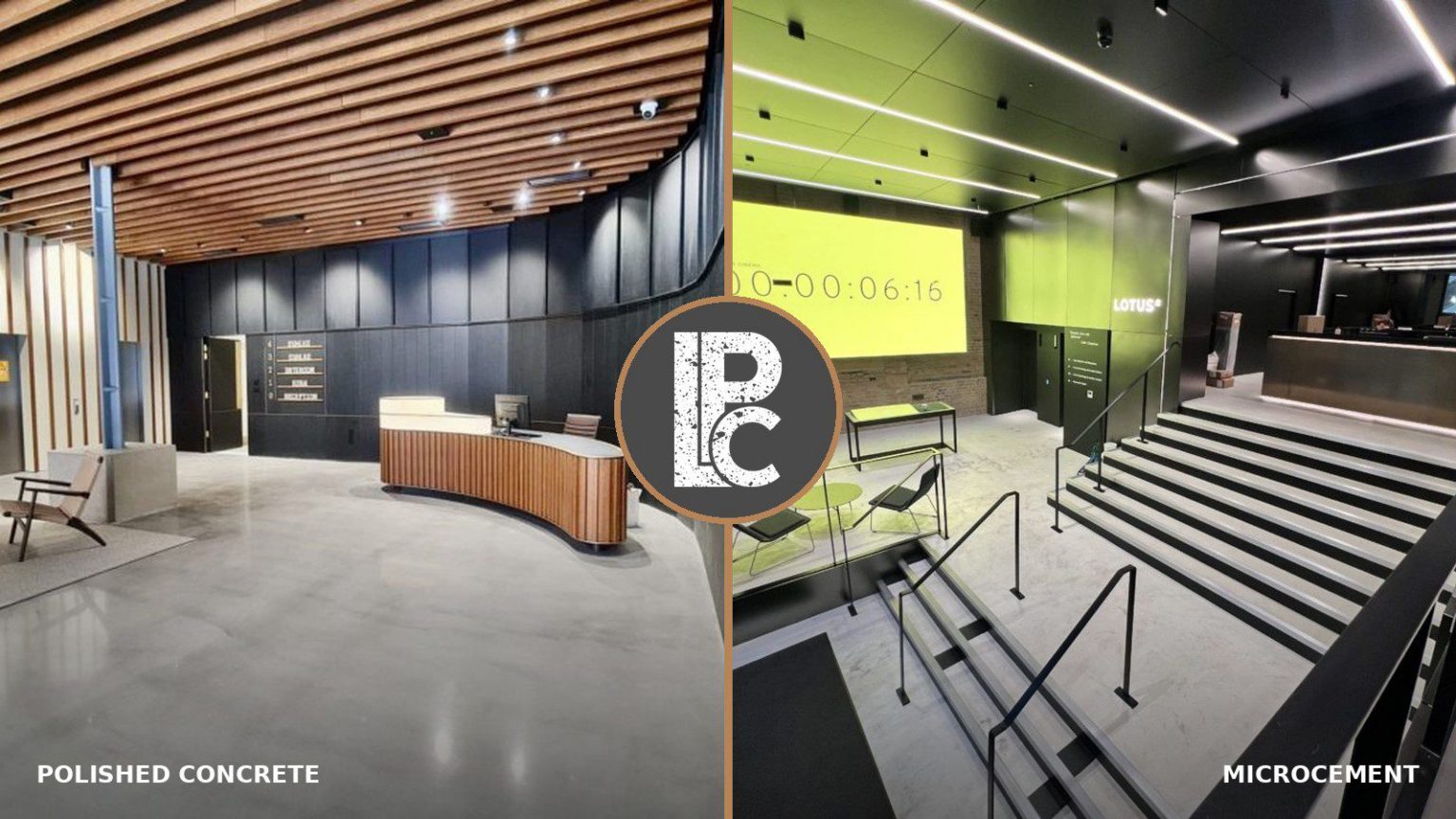
They photograph almost the same. They sit on the same mood boards. And they’re used interchangeably in briefs. But microcement and polished concrete are not the same material — or the same decision. One is a concrete floor, finished in the slab itself. The other is a thin, seamless skin you can wrap over almost any surface, including walls and wet areas.
This guide is for the people specifying them — interior designers, architects, contractors and developers working on design-led projects across London and the South East, from commercial fit-outs, hospitality and retail to whole-home renovations, extensions and basements. For any of them, the choice comes down to two questions: where does the finish need to go, and what’s underneath it? This guide answers both — and shows where each one wins.
The short answer
- Polished concrete is a floor — a concrete slab, typically around 100mm deep and reinforced, finished either by a colour hardener (the smooth cream finish) or by mechanical grinding and polishing (salt & pepper and exposed aggregate). Hard-wearing, monolithic, architectural.
- Microcement is a surface — a 2–3mm hand-applied overlay that can go on floors, walls, bathrooms, kitchens and even joinery, over substrates you already have.
If you need a statement floor on a new or existing slab, think polished concrete. If you need the concrete look somewhere a poured floor can’t go — a wall, a wet room, an upper floor, over existing tiles — think microcement.
What is polished concrete?
Polished concrete is the original, hardest-wearing polished floor finish — and it isn’t a single process. On a new floor it starts as a structural concrete slab (typically around 100mm, reinforced), and the finish is achieved in one of two ways, depending on the look:
- Colour hardened — the cream finish. A dry-shake colour hardener is worked into the fresh, wet concrete, then power-floated and burnished to a smooth, dense, coloured surface. The colour comes from the hardener and the floor is not diamond-ground — this is how you get that clean, even, near-seamless cream finish.
- Mechanically ground & polished — salt & pepper and exposed aggregate. Once the slab has cured, it’s diamond-ground to cut into the surface, then densified, sealed and polished. A shallow cut reveals a fine salt & pepper speckle; a deeper cut gives a fully exposed aggregate floor with visible stone.
Either way, the finish is the floor — there’s nothing applied on top to wear through. It suits large-format spaces — open-plan ground floors, extensions, basements, retail and commercial — and pairs beautifully with underfloor heating thanks to concrete’s high thermal mass.
What is microcement?
Microcement (our system is Hardcrete) is a polymer-modified cementitious coating applied by hand at just 2–3mm, then sealed. Because it’s so thin and bonds to what’s beneath it, it goes where poured concrete can’t: walls, floors, bathrooms, kitchens, stairs, even furniture and joinery — over existing tiles, screed, plasterboard or timber.
It’s seamless — no joints, no grout lines — which is exactly why designers reach for it when they want a continuous surface that flows from floor to wall to vanity. It comes in 40+ colours, so it delivers the concrete aesthetic with far more control over tone than a natural slab.
The head-to-head
| Polished Concrete | Microcement (Hardcrete) | |
|---|---|---|
| What it is | A concrete slab — colour hardened, or ground & polished | A 2–3mm cementitious overlay |
| Thickness | The slab itself | ~2–3mm — barely changes floor levels |
| Where it can go | Floors on a suitable slab | Floors, walls, wet areas, joinery |
| Goes over | New or sound existing concrete | Tiles, screed, plasterboard, timber + more |
| Look | Cream (colour hardened); salt & pepper or exposed aggregate (ground) | Hand-worked, cloudy, seamless concrete look |
| Colour | Dry-shake colours (hardened) or natural tones (ground) | 40+ colours to choose from |
| Walls & wet areas | No | Yes — a key strength |
| Underfloor heating | Excellent (high thermal mass) | Compatible, correctly detailed |
| Seams/joints | Designed control joints | Seamless, joint-free |
| Best for | Statement floors, large/commercial, new builds, basements | Renovations, apartments, bathrooms, wraparound surfaces, upper floors |
Choosing as an interior designer
This is where the decision gets practical. A few shortcuts:
- You want one continuous surface — floor running up into the walls, a seamless wet room, a microcement vanity or bath surround. → Microcement. Its joint-free, go-anywhere nature is unmatched for design continuity.
- You’re working in an apartment or on an upper/suspended floor, or over existing tiles or timber, where you can’t pour and grind a slab. → Microcement.
- You want a precise colour to sit with a scheme rather than whatever the concrete gives you. → Microcement (40+ colours).
- You’ve got a statement ground floor, extension or basement on a real concrete slab and want a monolithic, lifetime floor. → Polished concrete — colour hardened for a smooth cream finish, or mechanically ground for salt & pepper or exposed aggregate.
- You want visible stone and texture as a design feature. → Polished concrete, ground to salt & pepper or exposed aggregate.
And whichever way it leans, set expectations with the client early. Both finishes are natural and hand-worked, so an honest conversation about what’s achievable — and seeing real finished projects — prevents the gap between a Pinterest image and the delivered finish.
Can you use both? (Often the best answer)
You don’t always have to choose. Some of the most considered projects use both: a polished concrete floor on the ground-floor slab, with microcement continuing the same concrete language up the walls, through the wet rooms, and onto joinery where a poured floor simply can’t reach. Used together, they let the concrete aesthetic run through a whole building — each in the place it’s strongest.
Refurbishing an existing concrete floor
Not every project starts with a fresh pour. A large part of what we do is refurbishing existing concrete floors — taking a worn, painted or dated slab in a studio, office, retail space or substantial home and bringing it back to a clean, durable, design-led finish.
Where there’s a sound existing slab, grinding and polishing it is usually the most direct and hard-wearing route — the finish comes from the floor you already have, with no replacement and minimal disruption. Where the existing floor isn’t suitable to polish, or the brief calls for a specific colour or a continuous look across floors and walls, a microcement overlay restores the concrete aesthetic over the top.
Either way, it starts with a survey of what’s actually there — so we can tell you, honestly, what finish the existing floor will take before anything’s committed. It’s a route that suits commercial spaces and larger residential schemes especially well, where replacing a slab isn’t practical but the floor needs to perform and look the part.
How to choose, in one line
Is it a floor on a concrete slab? Polished concrete. Is it a wall, a wet area, an upper floor, or going over an existing surface? Microcement. Not sure? That’s exactly what a site conversation is for.
Frequently asked questions
Is microcement as durable as polished concrete?
Polished concrete is the hardest-wearing of the two — it’s a structural surface. Microcement, correctly applied and sealed, is highly durable and well suited to homes, bathrooms and commercial interiors; it’s a high-performance finish rather than a structural floor. The right choice depends on the location and use, not on one being “better.”
What’s the difference between a colour-hardened and a ground polished concrete floor?
Both are polished concrete, finished differently. A colour-hardened floor has a dry-shake hardener worked into the fresh concrete and is power-floated and burnished to a smooth, coloured cream finish — it isn’t diamond-ground. A ground floor is diamond-ground once cured to reveal a fine salt & pepper speckle or full exposed aggregate, then densified, sealed and polished. The cream finish is the smoothest and most uniform; ground finishes show more of the concrete’s character.
Can microcement go on floors, or just walls?
Both. Microcement is widely used on floors as well as walls — it’s one of the few finishes that does both seamlessly, which is why it’s a favourite for continuous floor-to-wall schemes.
Can you put microcement over existing tiles?
Yes — over sound, well-prepared tiles, screed, plasterboard and timber among others. That’s a major reason it suits renovations: it can transform a space without ripping everything out first.
Which is better for a bathroom?
Usually microcement — it’s seamless, waterproofable when correctly specified, and works on floors, walls and surrounds for a continuous wet-room look. Polished concrete is a floor finish and isn’t suited to walls or wet vertical surfaces.
Which works with underfloor heating?
Both, when detailed correctly. Polished concrete is especially good over UFH because of concrete’s thermal mass. Microcement is compatible too, with the right build-up and a controlled heating commissioning.
Is one cheaper than the other?
It depends entirely on the project — substrate, area, access and finish all drive the figure, so neither is reliably “cheaper.” The honest answer comes from looking at your specific space. See our polished concrete price guide or ask us for a tailored figure.
Find your finish
Every finish shown on a floor we actually installed, with the spec behind it — then tell us about your project and we will confirm the build-up.
Explore the finishes →Still not sure which is right?
Take the guesswork out of it. Browse the finishes explorer — each finish shown on a real LPC floor with its spec — then tell us about your project and we’ll confirm the right build-up.
When you get in touch, tell us about the project — the space, the approximate area, the location and your programme. We work on design-led commercial and residential projects across London and the South East, and the more we know, the sharper our advice.
Explore polished concrete and microcement, explore our Specification Support for architects and designers, or start a conversation. Talk to us on 020 7100 3887.
Concrete, considered.